
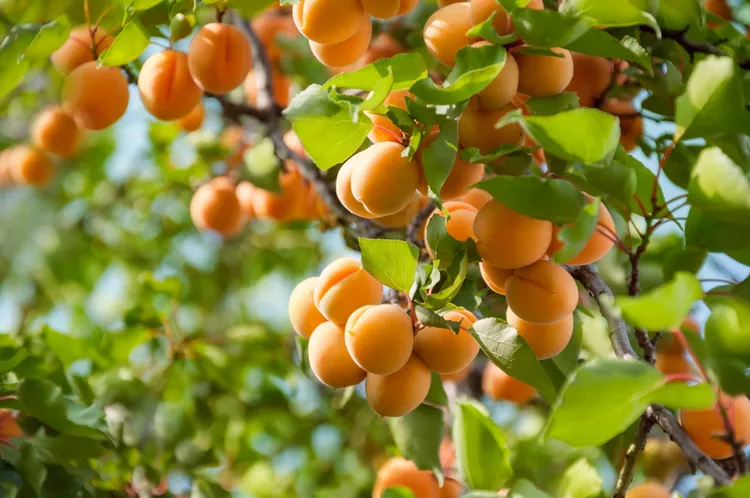
Apricot trees (Prunus armeniaca) provide sweet, juicy fruit and fill the landscape with delightful flowers and fragrance in early spring. One of the earliest stone fruits to bloom, apricot trees flower before cherry and peach trees, welcoming spring with dainty white and pink flowers that will perfume your yard and your neighbor’s yard.
Apricot trees grow 10 to 20 feet tall and wide, making them a great choice for many residential landscapes. Be sure to plant this fruiting tree in a spot where it receives at least eight hours of direct sunlight daily. Apricots are usually self-fruitful but produce a greater harvest if a second variety is planted nearby. When purchasing an apricot tree, pay close attention to its USDA Hardiness Zones to ensure it will thrive in your area.
Apricot Overview
| Genus Name | Prunus |
| Common Name | Apricot |
| Plant Type | Tree |
| Light | Sun |
| Height | 10 to 20 feet |
| Width | 10 to 15 feet |
| Flower Color | Pink, White |
| Foliage Color | Blue/Green |
| Season Features | Spring Bloom |
| Special Features | Fragrance |
| Zones | 4, 5, 6, 7, 8, 9 |
| Propagation | Stem Cuttings |
Where to Plant an Apricot Tree
Ample sunlight and well-drained soil are vital to growing apricot trees. The best planting location receives at least eight hours of direct sunlight daily. Be mindful of nearby trees or buildings that can shade a nearby apricot tree. In Zone 6 and colder, where plant hardiness might be challenging, look for a planting site protected from harsh winter winds. Choose a planting site that has loose, fast-draining soil. The right soil for apricot trees crumbles easily and feels somewhat sandy but clumps together when moist.
Avoid planting apricot trees in an irrigated lawn in arid regions, such as the desert Southwest. The water requirements for growing turf are much higher than those of apricot trees, and apricot trees are likely to perish in the consistently moist soil necessary to maintain a lawn in an arid area.
How and When to Plant an Apricot Tree
Plant apricot trees in spring as soon as the soil can be worked to allow them to become established before the heat of summer. Apricot trees are available as bare-root plants and container-grown plants. If you have a choice, opt for a container-grown plant for easy planting and establishment.
Most apricot varieties are self-fruitful—only one tree is needed to produce fruit. However, researchers have found that a tree will produce a greater harvest consistently when another apricot variety is planted nearby. When shopping, see the apricot variety description to learn what variety might boost fruit production.
Dig a planting hole as large as the young tree’s root ball. Take time to get the depth of the planting hole correct—when placed in the planting hole, the tree’s root flair, and the swollen area where the roots emerge from the trunk should be just above the soil line. For bare-root trees, dig a planting hole slightly wider than the roots and deep enough so the root flare is just above the soil line. Backfill the planting hole with native soil and deeply water the newly planted tree. Continue watering twice weekly for about two months or until the plant is firmly rooted. Aim to deliver five to 10 gallons of water a week.
Apricot Tree Care Tips
Light
Apricots grow best when planted where they receive at least 8 hours of direct sunlight per day. Prune the tree annually to remove excess growth in the center of the plant so that sunlight can penetrate the canopy.
Soil and Water
Fast-draining, loose soil is ideal for growing apricot trees. Wet or boggy soil is likely to bring on a host of diseases affecting the plant's roots, branches, and leaves. Apricots thrive with regular watering when they are young. Beyond the first growing season after planting, apricot trees rarely require supplemental water.
Temperature and Humidity
Apricot trees bloom in early spring. A late spring freeze can damage blossoms and prevent the tree from fruiting, but the tree will likely bear fruit in the next growing season. Choose an apricot variety that is hardy in your area to reduce the chance that a freeze kills the flowers.
Fertilizer
When planted in the home landscape, apricots don't require fertilization. The native soil generally provides all the nutrients the trees need to grow and produce fruit well. If growth is slow or stunted, test your soil to check its nutrient content.
Pruning
Prune apricot trees annually in late winter. Begin by removing all broken, rubbing, and diseased branches. Also, prune away vigorous stems, called suckers, rising from the roots or base of the trunk. Next, prune the tree to create a V-shape. Choose three to five main branches. Remove tightly spaced growth on the main branches, aiming to remove about 25 percent of the interior growth each year to allow light to penetrate the center of the tree and help ripen the fruit.
Not only do apricot trees require pruning of their woody stems, but they also thrive when excess fruit is pruned away. This is called thinning. Apricot trees are vigorous fruit producers and will likely set far more fruit in spring than can develop into large, tasty fruit in summer. When the fruit is the size of a grape, pluck away excess fruit so that there are at least 4 to 6 inches between each young apricot. Fruit thinning allows the remaining fruit to fully mature and maintain good tree health.
Pests and Problems
Several pests and problems plague apricot trees. Root diseases are common and show themselves by yellowing leaves, branch dieback, and general lack of vigor. Wet soil is often the cause of root diseases. Cankers—discolored bark and wounds that ooze sap—are another apricot tree challenge. Prevent cankers by avoiding tree injury; protect the trunk and lower limbs from lawnmowers and weed trimmers. When possible, prune out infected wood 12 inches below where the last symptoms appear.
How to Propagate an Apricot Tree
Apricot trees are propagated vegetatively to preserve the cultivar characteristics. In the home garden, stem cuttings are the best way to propagate an established tree.
Cuttings: In the fall, take a 6- to 9-inch cutting from a one-year-old branch that is about as thick as a pencil. Select a branch with three or four leaf buds and cut it at a 45-degree angle. Strip any leaves from the bottom half of the cutting, but leave a few on the top half. Fill a pot with peat moss or damp sand, moisten the cut end of the cutting, and dip it in rooting hormone before burying it several inches deep in the pot. Place the pot in bright, indirect light and water it regularly until the sapling shows new growth in spring, indicating it is ready to be transplanted in the garden.
Types of Apricot Tree
'Harcot' Apricot Tree
Prunus armeniaca ‘Harcot’ has medium to large orange fruit. It is self-fruitful and has good disease tolerance. It ripens in July. Zones 4–9.
'Moorpark' Apricot Tree
Prunus armeniaca ‘Moorpark’ has large golden-yellow fruit that is juicy and well-suited for fresh eating, canning, and drying. It is self-fruitful and ripens in mid-July. Zones 4–8.
'Puget Gold' Apricot Tree
Prunus armeniaca 'Puget Gold’ produces elongated fruit with tangerine-orange skin and warm orange flesh that has an intense flavor. It is self-fruitful and ripens in August. Zones 5–9.