
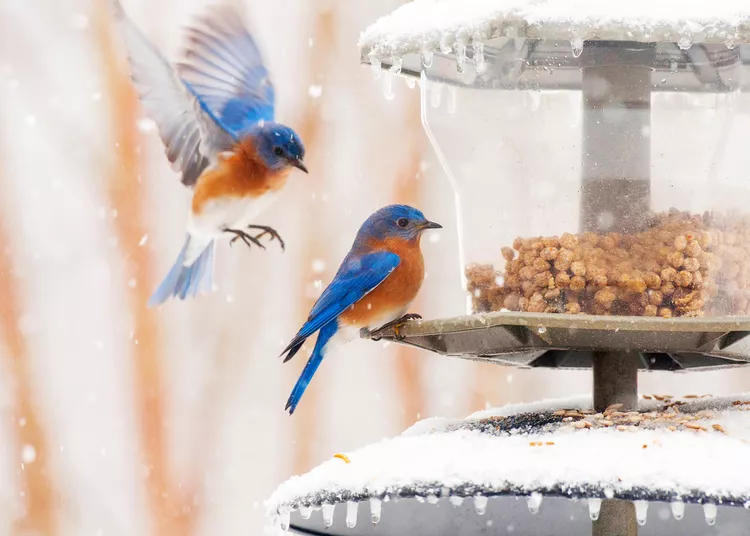
Watching wild birds in your yard is a delightful activity any time of year. Although some favorites, such as hummingbirds, migrate to warmer places in winter, many other species stick around. There's a few things you can do to help these hardy birds when the weather turns cold. Natural food sources become scarce in winter, so backyard birds will benefit more than ever from feeders stocked with nourishing food. Having a few plants around the yard with berries or seeds that last into the colder months also helps. And your feathered friends are sure to appreciate access to clean, ice-free water too. Use these tips to attract and feed wild birds in your yard all winter long.
1. Keep Safety in Mind
"If we are attracting birds with food resources, it is important that we protect them when they show up," says Becca Rodomsky-Bish, project leader of the Great Backyard Bird Count for the Cornell Lab of Ornithology. Because snow can make windows even more reflective, she suggests making sure your windows have screens, decals, or other forms of protection to break up reflections so birds don't collide with them. Also, keep cats indoors so they don't jump on unsuspecting feeding birds.
Joe Liebezeit, staff scientist and avian conservation manager of Portland Audubon Society, says, "To prevent feeders from becoming point-sources of disease, clean and bleach them at least once a week." He suggests cleaning with soap and water, then soaking in a 10% bleach solution for 10 minutes followed by a thorough rinsing.
Liebezeit also suggests steering clear of platform feeders, "because birds stand on them and tend to defecate where the food is, increasing chances of spreading diseases."
2. Create Habitat
Trees and shrubs, particularly evergreens, provide perches for birds to rest and shelter from rain, snow, wind, and predators. Make a brush pile in an out-of-the-way spot in the yard with trimmed branches where birds can find shelter. Roosting boxes and birdhouses also provide safe places for birds to escape the elements. Be sure to clean them out in the fall and again in spring.
Many plants can add beauty to your garden while also serving as a welcoming habitat for wild birds. Trees and shrubs that bear fruit persisting into winter, such as hollies, many viburnums, hawthorns, staghorn sumac, and wax myrtle, provide natural food sources for birds. And don't be too quick to cut back perennials that bear seeds. Coneflowers, black-eyed Susans, many ornamental grasses, and a number of other native plants can serve up bird-satisfying meals all winter long.
3. Select Nourishing Foods
In winter, birds need more calories to stay warm and to move about, so make sure to stock your feeders with foods that are rich in fats and oils. Black oil sunflower seeds ($16, Walmart) and thistle seeds ($14, Walmart) appeal to a wide variety of birds. Hulled peanuts also make a nourishing meal for birds, and are a favorite of black-capped chickadees, nuthatches, woodpeckers, and blue jays.
Suet is a superfood for birds in winter, particularly birds that feed on insects during the warmer months. "The birds appreciate the extra fat in the chilly weather," says Emma Greig, project leader at Project Feederwatch at the Cornell Lab of Ornithology. Tuck suet cakes ($13, Chewy) into empty onion sacks or wire cages and hang them in a tree. Or use a specially-designed suet feeder ($17, The Home Depot). If you are a DIY kind of person, try making your own suet cakes. Wrap finished cakes in parchment paper and freeze until you're ready to use them. (This is an easy project to do with kids!)
4. Keep Feeders Protected and Filled
Locate your feeders in a spot that's shielded from strong winds. Downwind of tall evergreen trees or in the shelter of a porch is often ideal. It's best to have some open space around feeders so birds can watch for danger, with perching spots nearby so they can easily access cover from predators.
Keep feeders covered, if possible, to protect the food from rain and snow. When it snows, shovel or pack down the snow beneath feeders so that fallen seed can be easily found by ground feeders, such as mourning doves. Be consistent and keep those feeders stocked, especially when the weather is severe.
5. Provide Water Sources
Birds can't live on food alone; they also need water. "Providing fresh water is as important, if not more important, for feeding birds in the winter," says Rodomsky-Bish. "Consider adding a birdbath or water dish near your food resource. Keep this water thawed and fresh," she adds. Ceramic birdbaths may crack in cold weather, so plastic or metal baths are safer. If you live where temperatures stay below freezing most of the winter, a birdbath water heater will safely prevent the water from turning to ice.