
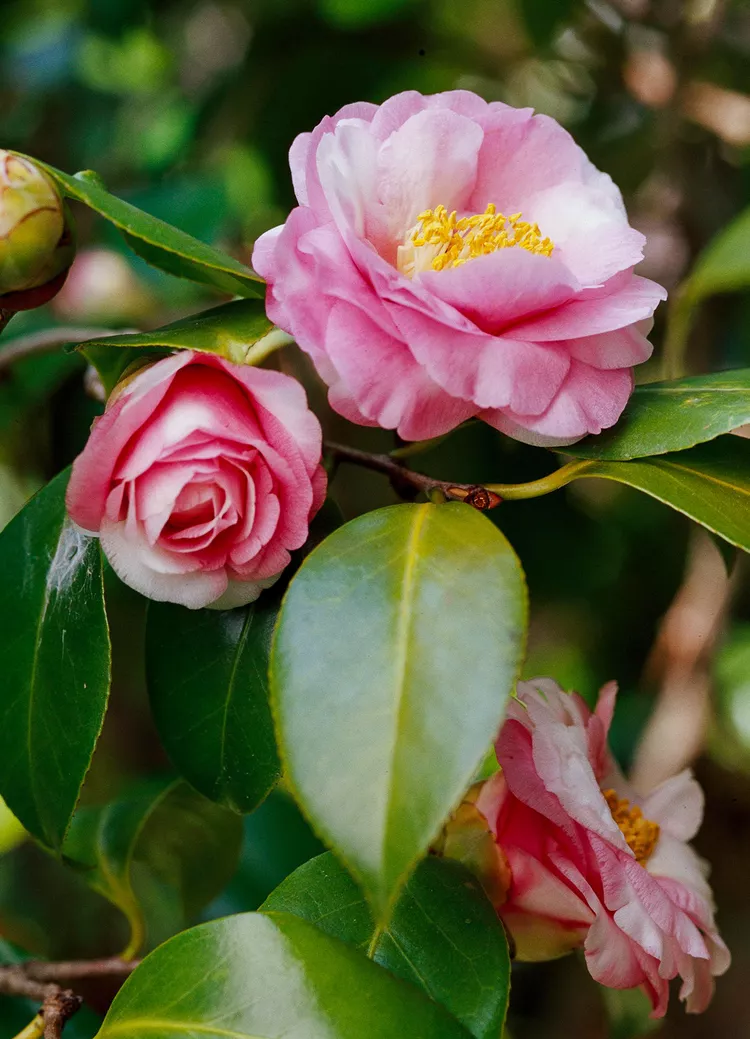
Camellia is a perennial shrub that comes in many shades of pink, red, and white. There are six types of blooms: single, semi-double, anemone, peony, rose form double, and formal double. Each form features a specific petal arrangement and number of petals. Bloom time varies in camellia shrubs depending on the species. Some bloom in the spring, fall, or even winter in mild climates. Species with small flowers tend to be the fragrant ones because breeding efforts for large formal types have focused on size rather than scent.
Camellia Overview
| Genus Name | Camellia |
| Common Name | Camellia |
| Plant Type | Shrub |
| Light | Part Sun, Shade, Sun |
| Height | 8 to 20 feet |
| Width | null to 20 feet |
| Flower Color | Pink, Red, White |
| Foliage Color | Blue/Green |
| Season Features | Fall Bloom, Spring Bloom, Winter Bloom, Winter Interest |
| Special Features | Cut Flowers, Good for Containers |
| Zones | 10, 6, 7, 8, 9 |
| Propagation | Seed, Stem Cuttings |
| Problem Solvers | Good For Privacy |
Where to Plant Camellia
Site camellias in part shade or dappled shade to help them grow best. Plant them at least 5 feet apart, because they need their space to get ample water and nutrients and don't like to compete with other, larger trees or shrubs for what they need.
How and When to Plant Camellia
Plant camellias in fall or early spring. In warmer areas, fall is better because plants have time to grow deep root systems without summer heat affecting them. Plant in the spring for best results where temperatures are cooler.
To help drain water away from their trunks, plant camellias so that the top of their root balls are slightly above the soil's surface. During their first year, camellias benefit from supplemental watering during dry spells. After that, they tend to be drought-tolerant. Shelter plants from strong winds, especially in the upper South or near the coast.
Camellia Care Tips
Camellias are fairly easy to grow, requiring many of the same conditions as other broadleaf evergreens like rhododendrons and azaleas. In fact, they're often used as a companion plant to azalea and rhododendron shrubs.
Light
Plant young camellia plants under the protective shade of large trees. The bigger they grow, the more their flowering shrubs will protect the roots and the more sun they can accept. Check what the type of camellia you plant requires regarding sunlight because some varieties need more than others.
Soil and Water
The soil for camellias should be slightly acidic (6 to 6.5 pH), well-drained, and rich in organic matter. Supplement poor soil by raking compost or manure into the topsoil.
Keep camellias' soil moist to a depth of 14 to 18 inches to encourage the best bud growth. If the soil gets dry, buds will have fewer petals, and the flowers won't look as lush as they can. Water twice a week, up to 1 inch per week. Keep the soil moist by adding 3 inches of mulch, which also helps to suppress weeds.
Temperature and Humidity
Camellias prefer cooler temperatures but will be harmed by frost. Plant camellias in north-facing locations with a wind guard like a wall or a building to protect them from damage. In spring, 50 degrees is ideal for camellias, while winters should remain between 40 and 50 degrees with sunlight. They thrive in a more humid environment, one reason they're hardy in Zones 6-10.
Fertilizer
There are fertilizers specifically for camellias and azaleas. Use one to manage the soil acidity. They like nitrogen-rich fertilizer that's slow-release. Fertilize in early and late spring and again in mid-summer.
Pruning
Prune camellias in late spring, after they flower, for a bushier shrub. Cut away dead branches or any that show signs of disease or blight. Don't prune too much, just what's necessary to keep the shrub healthy and manageable.
Pests and Problems
Watch for petal blight in spring. This fungus turns petals brown, then kills the whole flower. The best solution is to remove affected flowers and debris from around the plant, then treat it with a foliar fungicide at least twice a month.
Camellia scale (also known as tea scale) is the name for small white to gray insects that affix themselves to the undersides of leaves close to the stem. Though generally not fatal, the insects can weaken the plant. Handpicking the pests can alleviate the problem, but smothering scale and their eggs with horticultural oil may be more effective.
How to Propagate Camellia
Propagate camellias by layering for speedier growth. They can be grown from seed, but it takes a long time for plants to develop.
To propagate, do this during the summer:
- Bend a long plant stem down to the ground and cut a nick at an angle.
- Bury the wounded area in the ground after looping the stem into the soil. Use a rock or stiff wire to keep it in place.
- The wounded part of the stem will create a network of roots over an entire growing season. Once this happens, point, clip it away from the original plant, and move it to a new location.
Types of Camellia
'Granada' Camellia
This variety of Camellia japonica produces semidouble to peony-shape deep red flowers in mid-spring. It grows 20 feet tall and 10 feet wide in Zones 7-8.
'Alexander Hunter' Camellia
Camellia japonica is an upright shrub with sweeping branches bearing single or semidouble, deep red blooms in early and mid-spring. It grows 20 feet tall and 10 feet wide in Zones 7-8.
'Helen's Ballerina' Camellia
Camellia japonica has a vigorous, open habit and produces large double, pale peachy-pink blooms late in the season. It grows 20 feet tall and 10 feet wide in Zones 7-8.
'Julia Drayton' Camellia
This upright shrub of Camellia japonica bears double and semidouble crimson purple-tinged flowers in mid-and late spring. It grows 20 feet tall and 10 feet wide in Zones 7-8.
'Miss Universe' Camellia
Camellia japonica 'Miss Universe' is a prizewinner worthy of the name, producing large double white flowers on a shrub that grows 20 feet tall and 10 feet wide in Zones 7-8.
'Lila Naff' Camellia
This variety of Camellia japonica bears soft, silvery pink blooms in mid-to-late spring on a shrub that is slow growing and upright. It grows 20 feet tall and 12 feet wide in Zones 7-8.
'Kramer's Supreme' Camellia
Camellia japonica produces double, big, bountiful blooms of rose-red in late fall and again in late spring. It grows 20 feet tall and 10 feet wide in Zones 7-8.
Zones: 7-8
'Elegans' Camellia
Anemone-shaped rose-pink blooms make this variety of Camellia japonica stand out with its summer color. It grows 20 feet tall and 10 feet wide in Zones 7-8.
'Coquettii' Camellia
This variety of Camellia japonica is a slow-growing selection that bears deep red blooms, sometimes double, in mid-to-late spring. It grows 20 feet tall and 10 feet wide in Zones 7-8.
Tea Plant
Camellia sinensis is commonly called tea plant. Small, white to pink single blooms are borne in fall in Zones 6-9.
Camellia Companion Plants
Hosta
Also called plantain lily, hostas come in diverse foliage shapes, colors, textures, and sizes. In addition, hosta leaves come in a wide range of hues, from an almost navy blue to a pale, creamy white.
Rhododendron
A shrub with broad evergreen leaves, rhododendrons also boast large clusters of showy blooms in spring. In areas with dry winters, deciduous varieties can fill in the gap.
Hydrangea
Hydrangeas can flourish in sunshine or dappled shade, depending on the type. Huge bouquets of hydrangea flowers are beautiful from summer to fall. Varieties of hydrangea differ in size, flower shape, color, and bloom time.