
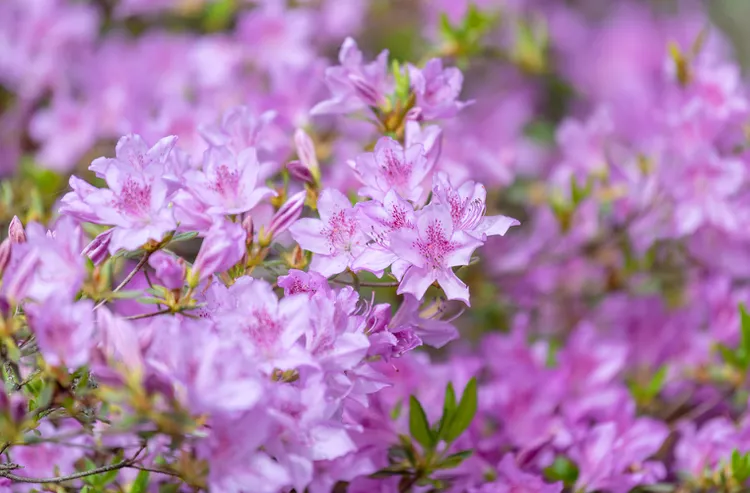
A classic shade garden plant, rhododendrons are prized for their glossy green foliage and showy clusters of blooms. Available in a variety of hues, the most common flower colors are purples and pinks, as well as white and cream. The Rhododendron genus contains an option for every landscape, from the giant rhododendrons of East Asian mountainsides to the rosebay rhododendrons native to Eastern U.S. woodlands. In areas where dry winters tend to desiccate evergreen types, deciduous varieties of rhododendrons can fill in the gap. Many deciduous types also boast bright yellow and orange hues that work wonders in brightening up shady corners of the garden.
When ingested, the leaves, nectar, seeds, and flowers of rhododendrons and azaleas are toxic to humans and pets.
Rhododendron Shrub Overview
| Genus Name | Rhododendron |
| Common Name | Rhododendron Shrub |
| Plant Type | Shrub |
| Light | Part Sun, Shade |
| Height | 3 to 8 feet |
| Width | null to 25 feet |
| Flower Color | Orange, Pink, Purple, Red, White, Yellow |
| Foliage Color | Blue/Green |
| Season Features | Fall Bloom, Spring Bloom, Summer Bloom, Winter Interest |
| Special Features | Fragrance, Good for Containers |
| Zones | 10, 3, 4, 5, 6, 7, 8, 9 |
| Propagation | Layering, Seed, Stem Cuttings |
| Problem Solvers | Deer Resistant, Good For Privacy |
Rhododendron or Azalea?
Rhododendrons and azaleas are often confused. Azaleas were once considered a separate genus of plants, but they were reclassified as genetically similar to rhododendrons relatively recently. Now, they are in the same genus. People tend to think of rhododendrons as large evergreen plants with big clusters of blooms and associate azaleas with smaller leaves and shorter plant habits.
Where to Plant Rhododendron
Rhododendron plants, like many other plants in the Ericaceae family, prefer acidic soils. Many of the evergreen types can be susceptible to burn in winter where they are exposed. To prevent this, plant evergreen types in sheltered areas, avoiding southern exposures where warm, sunny winter days can be fatal. Keep them sheltered from drying winter winds as well.
Rhododendron Care Tips
Light
Most rhododendrons prefer a shade-filled existence, but newer varieties are available for sunny areas as well. Deciduous varieties can hold up much better to more sun.
Soil and Water
The ideal soil pH for rhododendron plants is somewhere between 4.5 and 6.0. If you have had problems growing rhododendrons in the past, perform a soil test. You can amend the soils with peat moss, compost, and other soil acidifiers to keep them happy.
Rhododendrons also appreciate soil that has lots of organic matter. This will keep the shrubs decently moist and prevent them from drying out (dry winters and late falls can be particularly fatal to rhododendrons). On the other end of the spectrum, overly wet soils can also be fatal to rhododendrons. Finding the right balance of moisture in soils can be tricky.
Fertilizer
Fertilize rhododendrons and azaleas soon after blooming ends. Add a slow-release granular fertilizer to the soil or mulch around the plants. Use a fertilizer especially labeled for rhododendrons or a high-quality compost.
Pruning
Pruning may be necessary to create a more desirable shape and overall more visually appealing plant. After the plants have bloomed, spent blossoms can be cut back to the new growing tips. After bloom is also the ideal time to do any other pruning. Damaged or diseased growth should always be removed to prevent the spread of disease. You can also do rejuvenation pruning by cutting older plants back more severely to encourage better branching.
Pests and Problems
Rhododendrons and azaleas are not particularly susceptible to insects, but they sometimes are afflicted by lace bugs, borers, or weevils. Prevent an infestation by choosing resistant species or hybrids that show resistance and by keeping the area around the plant cleaned up.
Gardeners who live in areas with a large deer population may have a problem growing rhododendron. Deer love to munch on the leaves of the plant. In these areas, gardeners need to be willing to share, erect fencing or plastic mesh barriers, or use a spray that repels deer.
Evergreen types may begin to curl their leaves during the winter. This is a physiological response to dry winter weather. By curling their leaves, they are protecting themselves from cold temperatures and winds to prevent potential winter burn.
How to Propagate Rhododendrons
The easiest method for a home gardener to propagate a rhododendron or azalea is by layering an existing plant. Weigh a lower branch down until it touches the soil. Cut a slit in the branch where it touches the soil and apply a rooting hormone. A couple of years later, cut the rooted branch to separate it from the parent and transplant it.
Another propagation method is by stem cuttings taken from new growth in the early fall. Dip the cuttings in rooting hormone, plant them in a planting medium and keep them in a warm place. Rooting occurs anywhere from 6 weeks to 4 months later.
When growing from seeds, sow them indoors in early winter on top of a moist potting soil. Maintain a high humidity, warm environment with no direct sunlight. Transplant the tiny seeding to individual pots. It will be about two years before they can be planted in the ground.
Types of Rhododendron
With close to 1,000 species in the Rhododendron genus, picking just one is difficult. So don't—pick several instead! Here are some favorites.
Encore Autumn Chiffon Azalea
Rhododendron 'Robled' offers light pink flowers in spring, summer, and fall. It grows 3 feet tall and wide. Zones 7–9
Bloom-A-Thon Rhododendron
A series of semi-evergreen azaleas that feature a re-blooming habit for season-long color. Zones 6–9
'Blue Diamond' Rhododendron
Rhododendron 'Blue Diamond' is a dwarf evergreen rhododendron that bears violet-blue flowers. It grows 5 feet tall and wide. Zones 7–9.
Bollywood Rhododendron
Beautiful cream variegated foliage sets this variety apart, with bright magenta flowers in the spring on dwarf plants that make great container plants. It grows 2–3 feet tall and wide. Zones 6–9.
'Capistrano' Rhododendron
Rhododendron 'Capistrano' is a compact, mounding selection, growing to 4 feet tall and wide, bearing trusses of frilled greenish-yellow flowers. Zones 6–8.
'Cecile' Azalea
Rhododendron 'Cecile' grows vigorously to become a dense, 7-foot-tall and 7-foot-wide shrub with trusses of large, salmon-pink flowers. Zones 5–8.
'Hydon Dawn' Rhododendron
Rhododendron 'Hydon Dawn' is one of the few rhododendrons that tolerates full sun. It has a low, compact growing habit of 5 feet tall and wide and bears clusters of small, clear pink flowers that fade to white. Zones 7–9.
'Fielder's White' Azalea
Rhododendron 'Fielder's White' is blanketed with single white blossoms in mid-spring. Evergreen foliage complements the 3-inch-wide flowers on this variety. Zones 8–9.
'Gibraltar' Azalea
Rhododendron 'Gibraltar' grows vigorously to 5 feet tall and wide, bearing bright orange flowers. Can tolerate full sun. Zones 5–8.
'Karen' Azalea
Rhododendron 'Karen' is a hardy evergreen azalea bearing purple flowers in spring. It grows 3 feet tall and wide. Zones 4–9.
'Mandarin Lights' Rhododendron
A deciduous type of azalea, it features bright orange blooms in spring on naked stems before the foliage emerges. It tops out around 4–5 feet tall. Zones 3–7.
'Purple Dragon' Azalea
Rhododendron 'Purple Dragon' features striking dark purple-red flowers that open at the branch tips in late spring. The shrub grows 3–4 feet tall and wide. Zones 7–9.
'Hino Crimson' Azalea
Rhododendron 'Hino Crimson' is a dwarf, densely growing azalea that produces bright red flowers. It grows 2 feet tall and wide. Zones 5–8.
Korean Azalea
Rhododendron yedoense poukhanense bears lilac to deep-rose funnel-shaped flowers in spring. In fall, leaves change to a gold or reddish purple. It grows 6 feet tall and wide. Zones 5–9
'Nova Zembla' Rhododendron
Rhododendron 'Nova Zembla' is a large evergreen shrub that bears trusses of deep red flowers with spotted throats. It grows 5 to 10 feet tall and wide. Zones 5–8.
'Nuccio's Carnival' Azalea
Rhododendron 'Nuccio's Carnival' presents a profusion of large, single to semi-double magenta blossoms that add a burst of color to the landscape. Flowers are backed by rich green evergreen foliage. Zones 8–9.
'Olga Mezitt' Rhododendron
Rhododendron 'Olga Mezitt' is an evergreen selection that produces small trusses of deep peach-pink flowers. The leaves redden in fall. It grows to 4 feet tall and wide. Zones 4–8.
'Rose Queen' Azalea
Rhododendron 'Rose Queen', a cotton candy-pink cultivar, has ruffled flowers in mid-spring. It grows 4-6 feet tall and wide. Zones 8–10.
'Sun Chariot' Rhododendron
Rhododendron 'Sun Chariot' is an upright, dense-growing spring-blooming variety that grows 6 feet tall and wide. It bears yellow blooms with orange blotches in large clusters. Zones 6–9.
'Trude Webster' Rhododendron
Rhododendron 'Trude Webster' forms a compact, upright plant with clustered, clear pink flowers. It grows 5 feet tall and wide. Zones 6–9.
Garden Plans for Rhododendrons
Foundation Garden
A colorful alternative to the standard all-green landscape, this foundation planting mixes broad-leafed evergreen shrubs and a sculptural tree with flowering perennials and groundcovers.
Year-Round Excitement Garden Plan
Creating a garden around foliage is a surefire way to produce multiseason interest. While most garden beds focus on flowers, this mixed border emphasizes foliage plants of varying heights and textures, and throws flowers in for interest.