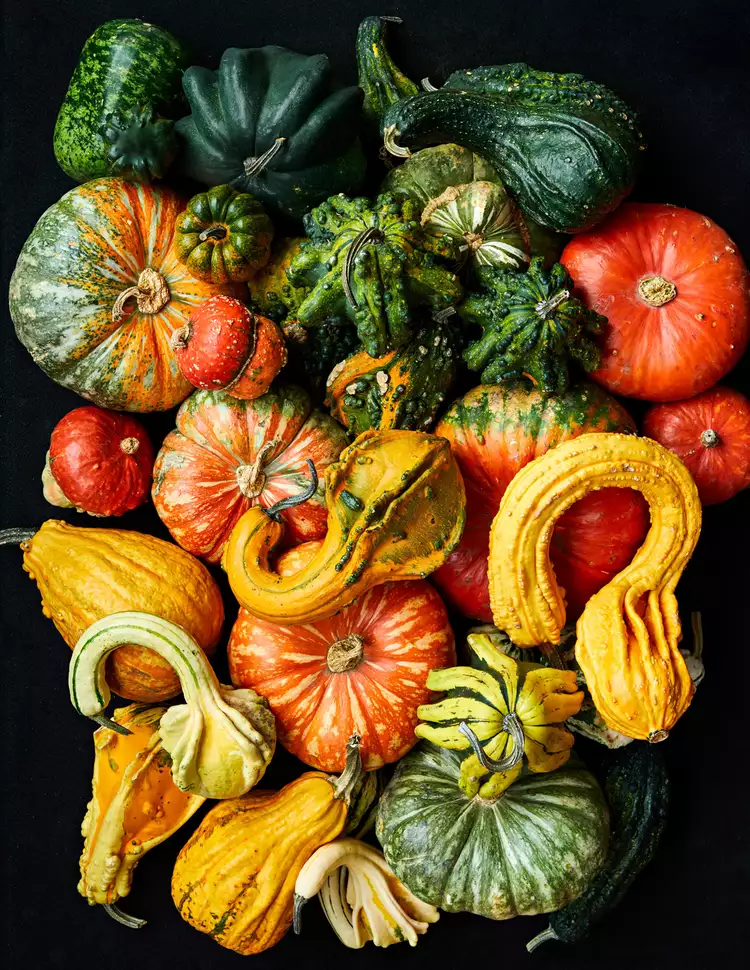
Try to describe any type of gourd; you might find it trickier than you thought. Perhaps the word makes you think of gnarly squash-like fruits that show up with pumpkins in the fall. However, different types of gourds come in many shapes and colors and range from the size of a large egg to larger than a bushel basket.
Dried gourds can be stained, painted, waxed, or carved into dippers, birdhouses, toys, bowls, and planters. Musical instruments such as flutes, lutes, maracas, and drums can be fashioned from the hard-shelled fruit. Did you know that the loofah sponge comes from a gourd? Small gourds, left whole, add splashes of color to autumn decor.
What Is a Gourd?
Gourds, like pumpkins, melons, squash, and cucumbers, are members of the cucurbit or squash family. Like their cousins, gourds grow on long vines. There are three major gourd groups. Cucurbit gourds are small, decorative, colorful, thick-shelled, and sometimes warty. Lagenaria gourds are bigger and can be used for various practical or decorative functions. This group includes bottle, basket, and dipper gourds. The third group is the luffa gourd. Its elongated fruit contains a fibrous material that is used as a sponge. Most gourds are strictly ornamental, but a few can be eaten, like summer squash, if harvested young.
Types of Gourds
1. Apple Gourd
Shaped like an oversized apple, these hard-shelled type of gourds (Lagenaria siceraria) grow six to eight inches tall and four to six inches across. In India, young fruit is added to curries. The skin is green with lighter green speckles or soft stripes but turns caramel brown as it dries. These gourds are great for crafting into birdhouses, bowls, or ornaments. When harvesting, be sure to leave a two-inch "apple stem" on the fruit.
2. Basket Gourd
Sometimes called bushel basket gourd (Lagenaria siceraria), it's the monster of gourds. These gourds are typically sphere-shaped but may be slightly flattened. Their tough green shells age to tan or gray; they make great storage containers once washed, dried, and waxed.
3. Bottle Gourd
Also called birdhouse gourd, trumpet gourd, or calabash, the bottle gourd (Lagenaria siceraria) has many uses. When young, it's an edible type of gourd and can be prepared similarly to summer squash. Allowed to mature, it can be hollowed out to make vessels, utensils, musical instruments, and birdhouses (especially purple martin houses). Each gourd has a rounded bottom and a neck that narrows and then widens to create a slightly bulbed end near the stem.
4. Daisy Gourd
The small, decorative daisy gourd (Cucurbita pepo) is about two to three inches in diameter and has a somewhat flattened, rounded shape. It comes in shades of yellow, orange, white, and green, and the stems are surrounded by colorful markings that form a distinct daisy pattern. Once dried, their naturally shiny surface can be coated with furniture polish to seal and enhance the sheen.
5. Dipper Gourd
Dipper gourds (Lagenaria siceraria) are favorite gourds of crafters for making scoops, spoons, and ladles. Each has a sphere-shaped base and a long, thin neck. This type of gourd has a neck that often curves, or even coils, if grown on the ground but will grow long and straight if allowed to dangle on a trellis. Although green on the vine, its smooth surface develops a tan color when dried.
6. Nest Egg Gourd
As their name suggests, oblong nest egg gourds (Cucurbita pepo) are the size and shape of a chicken or goose egg, and like eggs, they're white or light brown. Once dried, their smooth, hard surface makes them a good choice for painting as Christmas ornaments or Easter eggs.
7. Penguin Gourd
Also known as powderhorn gourds (Cucurbita sp.), the 10- to 16-inch-tall, crook-neck fruit is especially popular with crafters for creating fanciful penguins, round-bellied Santa figures, and other creatures. They also make cute birdhouses. Harvest some while they're small, and then you can create a whole penguin family.
8. Speckled Swan Gourd
An attractive heirloom variety type of gourd, the speckled swan gourd (Lagenaria siceraria) has a graceful appearance. Its enlarged, six- to eight-inch diameter spherical base and long, often curved neck with a bulbous tip make it look a bit like a swan. Grow the vine on a trellis so the fruit can dangle without becoming flattened on one side. Once dried, these gourds can be painted or carved with a wood-burning tool. They're very long-lasting, too.
9. Sponge Gourd
The luffa or sponge gourd (Luffa aegyptiaca) can be eaten when harvested very young. If left to mature, you'll be rewarded with a loofah sponge or natural dish scrubber. Harvest the gourds when the shell starts to harden and begins to separate from the interior fibers. Peeling away the shell reveals the sponge, which should be soaked, washed, and, if needed, bleached before use.
10. Winged Gourd
These small, thick-skinned gourds display irregular winged surfaces and may be warty or smooth. Some winged gourds (Cucurbita pepo) are solid-colored, in shades of yellow, orange, green, or white; others are multicolored, often displaying attractive patterns. With their vibrant colors and unusual shapes, these gourds make a great addition to autumn table arrangements.
Growing and Harvesting Gourds
Gourds need a long hot season (95 to 130 days) to mature, so unless you live where summers are long, you may want to get a head start by sowing seeds indoors. Provide plenty of sun, growing room, and, if possible, a trellis so the vines can climb.
Except for the luffa gourd, which is harvested before the skin completely hardens, allow the gourds to mature completely on the vine. Harvest when the stem begins to dry and turn brown using a sharp knife or garden snips. Leave a short stem attached. Handle the fruit with care to avoid bruising. Wash the gourds in soapy water to remove dirt. Then, wipe down the gourds with a soft cloth soaked in a household disinfectant and let them air dry or towel dry.
Cure the clean fruit in a well-ventilated shed or garage, spreading them in a single layer on newspaper or shelves. They shouldn't touch each other. Turn each gourd every few days and remove any that show signs of rotting. The curing process will take several weeks; you'll know they're thoroughly dried when you shake them and hear their seeds rattle. Dried gourds can be waxed, shellacked, painted, or used just as they are for decorating and crafts.