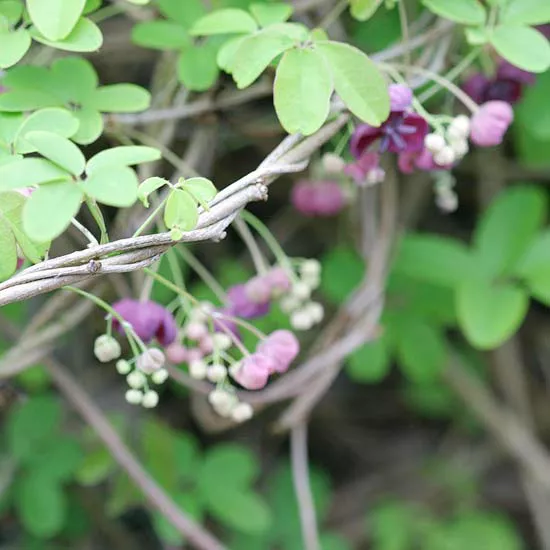
Akebia is a large deciduous perennial vine that can be grown in either sun or shade. In fact, it's one of the few perennial vines you can enjoy in a shade or woodland garden. In spring, this plant shows off delicate purple or white flowers that smell of chocolate. As enticing as that scent may be, it's the lush foliage that really makes this vine worth growing. The blue-green leaves are divided into leaflets, adding a wonderfully soft texture as the vine scales walls, pergolas, and other structures.
Give akebia a sturdy support—it grows large and heavy at maturity and may crush small structures. If springtime flowers are pollinated, akebia may produce edible, sausage-shape fruits. The vine usually needs a different variety planted nearby to produce fruit. Though edible, the fruit is not particularly tasty.
Akebia Overview
| Genus Name | Akebia spp. |
| Common Name | Akebia |
| Additional Common Names | Chocolate Vine |
| Plant Type | Vine |
| Light | Part Sun, Shade, Sun |
| Height | 8 to 30 feet |
| Width | 1 to 2 feet |
| Flower Color | Purple, White |
| Foliage Color | Blue/Green |
| Season Features | Spring Bloom |
| Special Features | Fragrance, Good for Containers, Low Maintenance |
| Zones | 4, 5, 6, 7, 8 |
| Propagation | Seed, Stem Cuttings |
Where to Plant Akebia
Because akebia grows fast when happy, it is ideal for creating a living privacy screen, blocking a view, disguising an eyesore, or creating a lush green wall. Be sure to plant it where you'll be able to see—and smell—the springtime blossoms up close. Even without flowers, akebia makes a great plant for the back of the property. Its fine texture fades into the distance and can help even small spaces feel larger. The vine will clamber over the ground but if you want it to climb, you will need to provide a sturdy support such as a fence, trellis, or pergola.
Because it is a large, fast-growing vine, akebia is best planted on its own, rather than with other vines. If you want to produce fruit, however, you will need another vine to improve chances for pollination.
Akebia has shown some invasive tendencies and has the potential to choke out native species in wild areas. It is considered invasive in certain states, including Michigan, Pennsylvania, Maryland, Virginia, New Jersey, West Virginia, Kentucky, Tennessee, North Carolina, South Carolina, and Georgia. Check local restrictions before planting it.
How and When to Plant Akebia
Plant akebia in the spring after all danger of frost has passed. Potted specimens require a planting hole roughly twice the size of their root ball, planted at the same depth as it is in the pot, a deep watering at planting time, and regular watering intervals as the roots take hold.
If you're planting more than one vine, give them a lot of space to grow. Allow at least 20 feet between plants.
Akebia Care Tips
Light
Grow akebia in full sun or morning sun with afternoon shade for best growth and flowering. When sited in full shade, this vine grows more slowly and blooms less than it would in full sun. In addition, the foliage doesn't get as dense.
Soil and Water
Akebia likes moist, well-drained soil that's rich in organic matter. It doesn't handle drought well, so keep it in a place where you'll be able to provide irrigation during periods of hot, dry weather. The vine is happiest with about an inch of water a week. As with most plants, providing a 3- to 4-inch-deep layer of mulch over the soil around the roots helps the soil stay moist longer in hot, dry weather. The mulch also suppresses weeds.
Temperature and Humidity
Akebia thrives in a temperature range of 55 to 86℉ and will tolerate some humidity. The plant loses its leaves in freezing winter weather but will grow them back in the spring.
Fertilizer
Akebia vine gets along just fine without much intervention. When planting in poor soil, add some compost to the backfill and then top dress with compost each spring if you want to give the plant a boost. Since it's such a rampant grower, though, it isn't a necessary step.
Pruning
A fast-growing vine that needs support, akebia responds well to pruning. In fact, you can cut it back significantly in winter if it grows out of bounds. Prune it less heavily in late spring after it's finished blooming if you want to enjoy more flowers the following year.
Potting and Repotting Akebia
While you can technically grow akebia in a container, it's not an ideal candidate due to it's vigorous and fast rate of growth. It can reach up to 40 feet in one season and requires a lot of space to spread out or a tall support to climb.
Pests and Problems
Akebia doesn’t have any serious pest or disease issues, which is partially responsible for its invasive tendencies. Its biggest issue is a tendency to take over wherever it grows.
How to Propagate Akebia
Propagate akebia via cuttings. Snip about 6 inches from new spring growth on an established vine and strip the leaves from the bottom half. Fill pots with moist potting mix and place the snipped stem, cut side down, into the mix. Firm the soil around the cutting and place it in a warm and humid spot for a couple of weeks. After about 3 weeks, check to see if roots are forming by gently tugging on the plant. If you feel resistance, the plant is rooting. Move cuttings to a warm, bright location to continue growing.
Cuttings can be transplanted outdoors when they reach a sturdy size. For a smoother transition, harden your seedlings off by placing them outside for a few hours a day (for 5 to 7 days) and increasing the outside exposure a little more each day. Choose a permanent spot for planting your cuttings because akebia doesn't like to have its roots disturbed.
Types of Akebia
'Alba' Akebia
Akebia quinata 'Alba' has green, hand-shape foliage divided into five leaflets along with small, white springtime flowers. This type of akebia limbs up to 30 feet. Zones 5-8
‘Purple Bouquet’ Akebia
Small maroon to purple flowers cover Akebia quinata ‘Purple Bouquet’ vine in spring with a light fragrance. New foliage also carries a purple tinge. It grows to a slightly smaller 30 feet. Zones 5-9
‘Variegata’ Akebia
Akebia quinata 'Variegata' offers green leaves splashed liberally with cream, providing an eye-catching backdrop to the purple-red blooms. It grows to 12 feet high. Zones 6-10