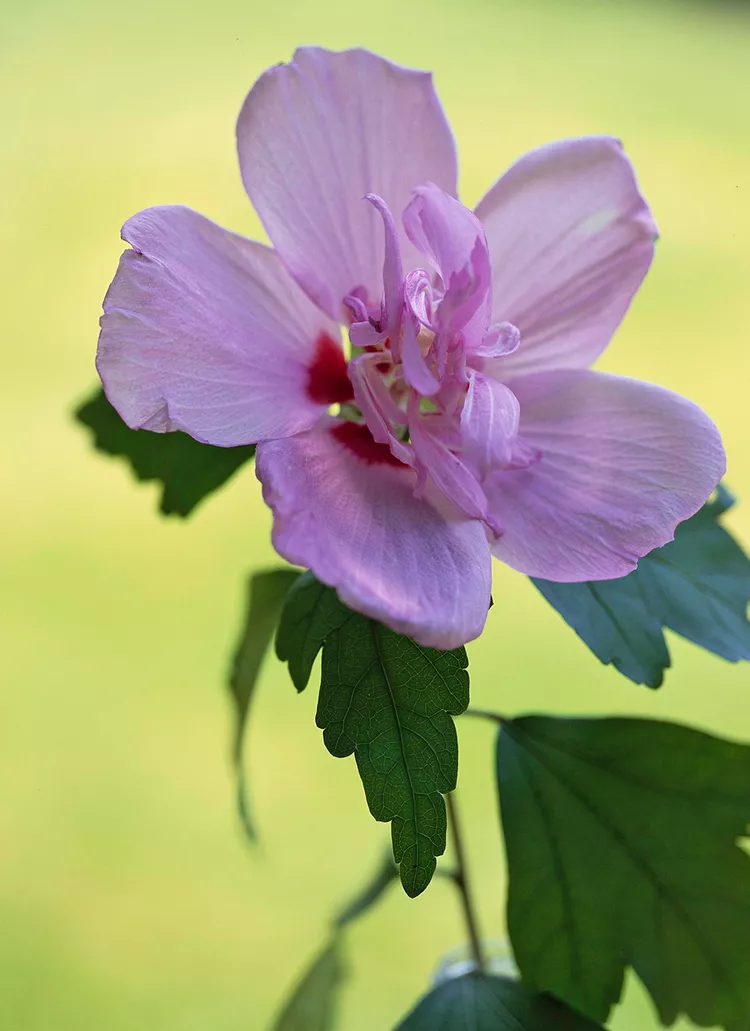
Rose of Sharon (Hibiscus syriacus) is a woody shrub that goes the extra mile when it comes to flowering. This easy-to-grow shrub or small tree begins unfurling its showy white, pink, or purple flowers in midsummer and continues producing new flower buds until the first frost. Taking up the flower show when many other shrubs are finished blooming for the season, rose of Sharon provides eight weeks or more of flower color.
Rose of Sharon is a favorite food source for hummingbirds, butterflies, and other pollinators. Plant it where you can enjoy the winged visitors it attracts. Rose of Sharon is a large plant, growing 8 to 12 feet tall and 6 to 10 feet wide, so situate it where it has plenty of space to expand.
Rose of Sharon Overview
| Genus Name | Hibiscus syriacus |
| Common Name | Rose of Sharon |
| Additional Common Names | Shrub Althea |
| Plant Type | Shrub, Tree |
| Light | Sun |
| Height | 8 to 12 feet |
| Width | 6 to 10 feet |
| Flower Color | Blue, Pink, Purple, White |
| Foliage Color | Blue/Green |
| Season Features | Fall Bloom, Summer Bloom |
| Special Features | Low Maintenance |
| Zones | 5, 6, 7, 8, 9 |
| Propagation | Stem Cuttings |
| Problem Solvers | Deer Resistant |
Where to Plant Rose of Sharon
Rose of Sharon is an easy-care plant for adding color to a mixed shrub border or foundation planting. Available as a large shrub or small tree, a single plant can serve as a specimen at the end of a long vista, or a few shrub types of rose of Sharon together create a living screen during the growing season. (Note: it is deciduous, so the screening effect is lost in winter.) Rose of Sharon shrubs can be planted and sheared as a formal hedge, or skip the shearing and call on it to form the backdrop for a pollinator garden. Dwarf varieties of rose of Sharon grow well in large containers.
Plant rose of Sharon in moist, well-drained soil and full sun or part shade. It flowers best when planted in a location that receives at least 8 hours of bright sunlight a day. When grown in part shade, it flowers less profusely and develops a somewhat gangly habit, as opposed to a more upright structure when planted in full sun.
How and When to Plant Rose of Sharon
Spring or early fall is the best time to plant rose of Sharon.
- Dig a hole as deep as the plant’s root ball. The width should be a couple of inches wider than the rootball.
- Set the plant in the hole, adjusting the depth so the top of the rootball is level with the surrounding soil.
- Backfill the planting hole with soil, tamping it down gently to remove air pockets.
- Water the plant deeply.
- Spread a 2-inch-thick layer of mulch over the root zone to help conserve soil moisture and prevent weeds.
Space several shrubs 6 to 10 feet apart. Dwarf varieties can be planted 3 to 4 feet apart.
Rose of Sharon Care Tips
Rose of Sharon is a low-maintenance plant that can live up to 20 to 30 years.
Light
Plant rose of Sharon in full sun or part shade. It flowers best when planted in a location that receives at least 8 hours of bright sunlight a day.
Soil and Water
Rose of Sharon tolerates a variety of soils but grows best in moist, well-drained soil. It reliably tolerates poor, infertile soil, sandy soil, or sticky clay as long as it drains well. Avoid planting it in boggy soil and areas with standing water.
Water rose of Sharon weekly during the first growing season after planting. Aim to provide at least 1 inch of water per week as it establishes a robust root system. Once established, rose of Sharon requires little maintenance and is drought and heat-tolerant.
Temperature and Humidity
Rose of Sharon thrives in heat and tolerates humidity with ease. This midsummer-flowering shrub seems to wait an eternity to come out of dormancy and begin growing in spring. It is not uncommon for rose of Sharon to leaf out as late as mid-June. It is easy to mistake it for a dead mass of branches when all the nearby shrubs and perennials are green and leafy. Give rose of Sharon extra time in spring. Once it begins growing and as the heat increases, it will mature quickly.
Fertilizer
Rose of Sharon does not need fertilizer. If the soil is lightweight, sandy, and generally lacking nutrients, mix a 2-inch-thick layer of well-decomposed compost in the root zone every spring. The compost will provide nutrients while enriching soil structure.
Pruning
Rose of Sharon doesn’t require pruning to grow and flower well, but annual pruning regulates the size of this fast-growing large shrub or small tree. Regular pruning also boosts the size of the shrub’s flowers. A rose of Sharon shrub or tree pruned in late winter or early spring will have fewer flowers than a plant that is not pruned, but the resulting flowers will be larger on the pruned shrub.
Remove damaged, diseased, or dead wood in late winter or early spring. Then, reduce overly long stems by one-third of their length and cut branches growing at wayward angles back to the main stem or base of the plant. Rose of Sharon tolerates pruning well, and the plants can be maintained at 5 to 6 feet tall and 3 to 4 feet wide if needed. Rose of Sharon can also be sheared.
Potting and Repotting Rose of Sharon
Small varieties of rose of Sharon can be planted in containers and enjoyed indoors or outdoors, but the rapidly growing plant—even a dwarf variety—soon outgrows a container. Start by planting the young shrub in a 12-inch pot with excellent drainage and good-quality potting soil. Position it in an area where it receives full sun. As it grows, move it to increasingly large pots, filled with fresh potting mix, moving up one size each time. Eventually, you might need to move it to an in-ground location.
Pests and Problems
This shrub doesn’t usually have serious pest problems, but it can fall prey to aphids and whiteflies, which can be treated with neem oil.
Rose of Sharon can sometimes spread aggressively by seed. A few varieties have been bred to be low-seed or no-seed to combat this problem. ‘Sugar Tip’, ‘Pollypetite’, ‘Azurri Blue Satin’, and ‘Purple Satin’ are all low-seed varieties.
How to Propagate Rose of Sharon
Rose of Sharon reseeds prolifically, so you can wait for the seeds to germinate in spring and transplant the seedlings when they are robust. If your rose of Sharon is a variety that doesn’t self-seed, taking stem cuttings is a method that results in an exact duplicate of your plant.
It is easy to propagate rose of Sharon with stem cuttings.
- In midsummer, take 4-inch stem cuttings from new growth. Remove the foliage from the bottom half of the cuttings.
- Dip the ends in rooting powder and insert them in small pots filled with a moist soilless mix.
- Position clear plastic loosely over the cuttings and put the pots in a shady location.
- After a week, remove the plastic and gradually move the pots to brighter light.
The roots take a month or two to develop, after which the plants can be transplanted into the garden.
Types of Rose of Sharon
There are many cultivars of rose of Sharon in a range of flower colors, some with single flowers and others sporting double flowers. You’ll find dwarf types and large types too.
Blue Chiffon
Blue Chiffon rose of Sharon (Hibiscus syriacus ‘Notwoodthree’) and others in the Chiffon series of rose of Sharon cultivars have semi-double flowers on shrubs with a graceful, rounded habit. In addition to the rare blue form, flowers in shades of pink, white, or purple are available in this series.
‘Helene’
Hibiscus syriacus ‘Helene’ offers a nonstop summer show of ruffled white flowers with a reddish-purple center. This large shrub grows upright with multiple stems and reaches 9 feet tall and 6 feet wide. It produces few or no seeds.
Lil’ Kim
Lil’ Kim (Hibiscus syriacus ‘Antong Two’) is a dwarf rose of Sharon about half the size of other varieties, growing to only 3–5 feet tall. It is covered with ruffled white flowers with crimson throats and is an excellent plant for small spaces or containers.
Sugar Tip
Sugar Tip (Hibiscus syriacus ‘America Irene Scott’) has bold pink, double flowers from midsummer to fall and creamy white with blue-green brightly variegated foliage. It grows to 10 feet tall and doesn’t produce seeds.
Rose of Sharon Companion Plants
Pair rose of Sharon with other flowering shrubs for a nectar-rich garden that will attract pollinators.
Weigela
Weigela shrubs put on a show of red or pink blooms in spring and early summer and then fade into the background as the seasons change. Weigela sizes range from 1 to 6 feet tall, depending on the variety. Weigela foliage colors range from green and gold to deep burgundy. These shrubs are moderately fast growers. Zones 4-9
Smoke Tree
Smoke tree adds colorful foliage to the landscape from spring to fall. Grown as a large shrub or small tree, the plant has oval leaves in shades of rich purple, gold, or green throughout the gardening season. When the weather cools in autumn, these plants turn shades of yellow, orange, and red. Hardy in Zones 5-8
Potentilla
Potentilla has crisp, neat foliage and charming flowers that resemble anemones. This hardy shrub blooms in a broad color range over a long period from late spring to autumn, attracting pollinators. When the leaves drop in fall, a reddish peeling bark is revealed. Zones 2–7